



Welcome to
Success by Design - Mastering the Business of Interior Design
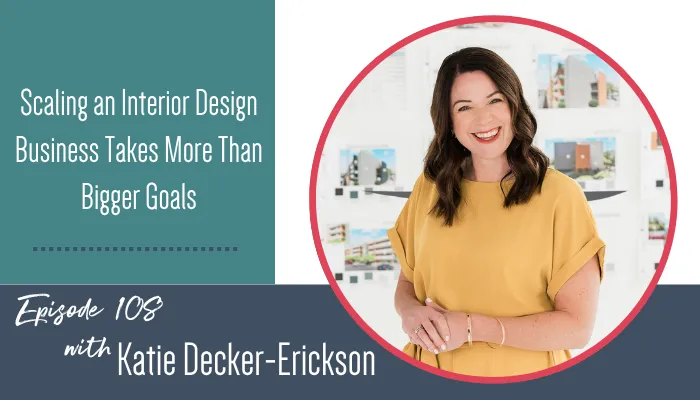
Scaling an Interior Design Business Takes More Than Bigger Goals
If you’ve been telling yourself that the next level of your business just requires you to “think bigger,” this might be the conversation you didn’t know you needed.
Because on the surface, that advice sounds right. Dream bigger. Charge more. Scale your firm. Step into your CEO role. It’s everywhere—and it’s incredibly seductive. But what I see behind the scenes with interior designers tells a very different story.
The designers I talk to every day are not lacking ambition. They’re not lacking talent. And they’re certainly not lacking vision. In fact, most of them can clearly see what the next level looks like.
But when growth actually starts to happen? Everything gets heavier.
More clients don’t feel like freedom—they feel like pressure. A bigger team doesn’t feel like support—it feels like more questions, more decisions, and more responsibility. And instead of stepping into that CEO role they’ve been chasing, they find themselves even deeper in the weeds.
If that feels familiar, you’re not alone.
Here’s the part no one really talks about: scaling doesn’t solve the problems in your business. It magnifies them.
So if your systems are loose, your boundaries are unclear, or your team relies on you for every decision, growth isn’t going to fix that. It’s just going to make it louder, faster, and harder to manage.
That’s why in this episode, I’m pulling back the curtain on what actually changes when a designer starts scaling well—not just scaling more.
We’re diving into the difference between motivational thinking (the kind that gets you excited) and strategic thinking (the kind that actually builds a business that can sustain growth). Because those are not the same thing, and confusing the two is where so many designers get stuck.
I’m also sharing what CEO thinking really looks like in practice. Not the buzzword version, but the kind that changes how you make decisions, how you structure your business, and how you lead your team.
Because stepping into that role isn’t about doing more. It’s about solving different problems.
And if you’ve ever had that moment where your business looks successful on the outside… but behind the scenes it feels like it’s being held together with duct tape and late nights, this episode is going to hit close to home.
We’re going to talk about why that happens, what it actually means, and the subtle shifts that start to change everything.
So if you’re ready to stop chasing “bigger” for the sake of bigger—and start building a business that can actually hold the growth you want—this is your next listen.
Go hit play on the episode.


I'm your host, Katie Erickson
I’m an interior designer with an MBA and nearly 20 years in the industry. When I’m not leading my coast-to-coast, multi-million dollar firm, I love sharing real talk on the business of design, blending insights from 20 years as a business professor. I keep it honest—balancing work and chasing my two girls around.
Scaling an Interior Design Business Takes More Than Bigger Goals
If you’ve been telling yourself that the next level of your business just requires you to “think bigger,” this might be the conversation you didn’t know you needed.
Because on the surface, that advice sounds right. Dream bigger. Charge more. Scale your firm. Step into your CEO role. It’s everywhere—and it’s incredibly seductive. But what I see behind the scenes with interior designers tells a very different story.
The designers I talk to every day are not lacking ambition. They’re not lacking talent. And they’re certainly not lacking vision. In fact, most of them can clearly see what the next level looks like.
But when growth actually starts to happen? Everything gets heavier.
More clients don’t feel like freedom—they feel like pressure. A bigger team doesn’t feel like support—it feels like more questions, more decisions, and more responsibility. And instead of stepping into that CEO role they’ve been chasing, they find themselves even deeper in the weeds.
If that feels familiar, you’re not alone.
Here’s the part no one really talks about: scaling doesn’t solve the problems in your business. It magnifies them.
So if your systems are loose, your boundaries are unclear, or your team relies on you for every decision, growth isn’t going to fix that. It’s just going to make it louder, faster, and harder to manage.
That’s why in this episode, I’m pulling back the curtain on what actually changes when a designer starts scaling well—not just scaling more.
We’re diving into the difference between motivational thinking (the kind that gets you excited) and strategic thinking (the kind that actually builds a business that can sustain growth). Because those are not the same thing, and confusing the two is where so many designers get stuck.
I’m also sharing what CEO thinking really looks like in practice. Not the buzzword version, but the kind that changes how you make decisions, how you structure your business, and how you lead your team.
Because stepping into that role isn’t about doing more. It’s about solving different problems.
And if you’ve ever had that moment where your business looks successful on the outside… but behind the scenes it feels like it’s being held together with duct tape and late nights, this episode is going to hit close to home.
We’re going to talk about why that happens, what it actually means, and the subtle shifts that start to change everything.
So if you’re ready to stop chasing “bigger” for the sake of bigger—and start building a business that can actually hold the growth you want—this is your next listen.
Go hit play on the episode.
Interested In Sponsoring The Podcast?
Scaling an Interior Design Business Takes More Than Bigger Goals
If you’ve been telling yourself that the next level of your business just requires you to “think bigger,” this might be the conversation you didn’t know you needed.
Because on the surface, that advice sounds right. Dream bigger. Charge more. Scale your firm. Step into your CEO role. It’s everywhere—and it’s incredibly seductive. But what I see behind the scenes with interior designers tells a very different story.
The designers I talk to every day are not lacking ambition. They’re not lacking talent. And they’re certainly not lacking vision. In fact, most of them can clearly see what the next level looks like.
But when growth actually starts to happen? Everything gets heavier.
More clients don’t feel like freedom—they feel like pressure. A bigger team doesn’t feel like support—it feels like more questions, more decisions, and more responsibility. And instead of stepping into that CEO role they’ve been chasing, they find themselves even deeper in the weeds.
If that feels familiar, you’re not alone.
Here’s the part no one really talks about: scaling doesn’t solve the problems in your business. It magnifies them.
So if your systems are loose, your boundaries are unclear, or your team relies on you for every decision, growth isn’t going to fix that. It’s just going to make it louder, faster, and harder to manage.
That’s why in this episode, I’m pulling back the curtain on what actually changes when a designer starts scaling well—not just scaling more.
We’re diving into the difference between motivational thinking (the kind that gets you excited) and strategic thinking (the kind that actually builds a business that can sustain growth). Because those are not the same thing, and confusing the two is where so many designers get stuck.
I’m also sharing what CEO thinking really looks like in practice. Not the buzzword version, but the kind that changes how you make decisions, how you structure your business, and how you lead your team.
Because stepping into that role isn’t about doing more. It’s about solving different problems.
And if you’ve ever had that moment where your business looks successful on the outside… but behind the scenes it feels like it’s being held together with duct tape and late nights, this episode is going to hit close to home.
We’re going to talk about why that happens, what it actually means, and the subtle shifts that start to change everything.
So if you’re ready to stop chasing “bigger” for the sake of bigger—and start building a business that can actually hold the growth you want—this is your next listen.
Go hit play on the episode.
Already running a high 6- or 7-figure design firm? Learn how Katie’s executive coaching helps top interior designers refine their operations, elevate their brand, and scale sustainably.


insightful conversations & super RELATABLE!
Excited for a podcast directed towards interior designers that covers the business and creative mindsets needed to run a successful firm. Throwing in life balance to every conversation makes this super relatable. Great conversations.
Colorful Conversations is like having a fun chat with your artsy friend who also knows how to create success! Katie's podcast is a must-listen for folks who love design and want to make money from their creative passions. She keeps you in the loop about the latest design trends while dropping priceless tips on turning your creativity into a successful business. Whether you're a design enthusiast or a budding entrepreneur, Katie's show is a goldmine of ideas and inspiration. So, tune in and get ready to blend style and success with her friendly and informative episodes – you won't want to miss it!
Why Don't you leave us a Review too?

Here's What listeners Are saying...
Listener Reviews
insightful conversations & super RELATABLE!
Excited for a podcast directed towards interior designers that covers the business and creative mindsets needed to run a successful firm. Throwing in life balance to every conversation makes this super relatable. Great conversations.
Colorful Conversations is like having a fun chat with your artsy friend who also knows how to create success! Katie's podcast is a must-listen for folks who love design and want to make money from their creative passions. She keeps you in the loop about the latest design trends while dropping priceless tips on turning your creativity into a successful business. Whether you're a design enthusiast or a budding entrepreneur, Katie's show is a goldmine of ideas and inspiration. So, tune in and get ready to blend style and success with her friendly and informative episodes – you won't want to miss it!
Why Don't you leave us a Review too?
Wenatchee, Washington 98801



Explore
successbydesign.coach- All Rights Reserved - Terms & Conditions - Cookie Policy