JOIN US OCTOBER 28: THE DESIGN BUSINESS DIAGNOSTIC WORKSHOP | REGISTER FOR FREE
Welcome To
The Cut Sheet

All Blogs
The Success by Design Framework | Grow Your Interior Design Business
Why Your Interior Design Business Isn't Working the Way It Should
The five areas to examine before making another expensive business decision.
You have clients. You have projects. Maybe you've even built a team and reached revenue milestones you once dreamed about.
So why does running your interior design business still feel so difficult?
Maybe you're bringing in more revenue than ever, but your bank account doesn't reflect it. Maybe you've hired people, yet somehow you're working more hours than you did before. Or maybe your calendar is looking a little too empty, and you're wondering whether you need to market more, lower your prices, or add another service.
Here's what I've learned after more than 20 years of building and running a multimillion-dollar design firm and coaching other interior designers:
The problem you notice first isn't always the problem you need to solve.
When business slows down, we assume we need more clients. When we're overwhelmed, we assume we need to hire. When profits disappoint, we assume we need to raise our rates.
Sometimes those are the right answers. But making those decisions without understanding what's actually happening inside your business can make things worse.
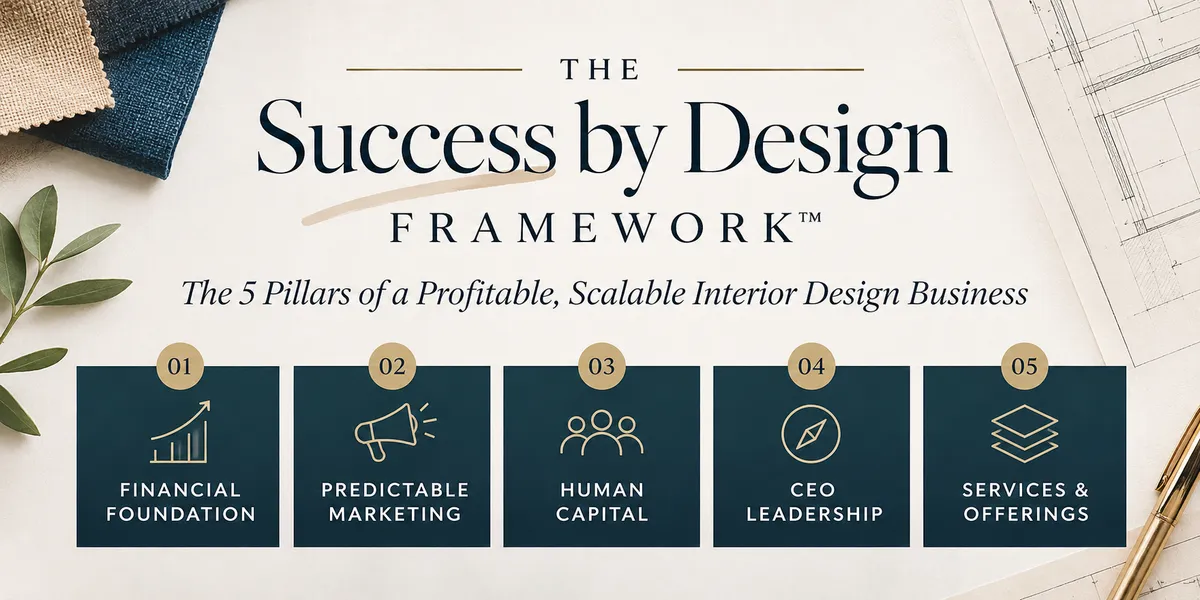
That's why I look at five interconnected areas when evaluating the health of an interior design business.
I call them the five pillars of the Success by Design framework, and they're the foundation of how I help designers build businesses that are profitable, sustainable, and designed around the lives they actually want to lead.
Let's look at each one.
1. Financial Foundation: Revenue Doesn't Tell the Whole Story
One of the most dangerous assumptions an interior designer can make is that growing revenue automatically means growing profit.
It doesn't.
I've seen designers generating substantial revenue who are struggling to pay themselves consistently. I've also seen smaller firms operating with much healthier margins and far less financial stress.
The difference isn't always how much they're selling. It's how well they understand their numbers.
Before deciding you need more clients, another employee, or higher prices, you should be able to answer a few fundamental questions:
What does it actually cost to operate your firm every month, including paying yourself?
How much revenue do you need to break even?
Which of your services produces the strongest profit margin?
How much money is owed to you, and when is it expected to arrive?
What does your cash position look like over the next 90 days?
That last question matters more than many designers realize.
Profit and cash flow are not the same thing. A profitable project on paper doesn't necessarily mean you have the cash available to cover payroll, procurement, or your next major expense.
And a $10,000 service isn't necessarily more profitable than a $5,000 service if it consumes three times the labor and resources.
Try this: Calculate your real break-even point
Start by identifying your fixed monthly operating costs, including an appropriate salary for yourself. Then look at how much of each revenue dollar remains after the variable costs of delivering your work.
For example, if your fixed expenses are $25,000 per month and your contribution margin is 50%, you need approximately $50,000 in monthly revenue just to break even.
Until you know that number, you're making growth decisions without a financial baseline.
Listen to Episode 128: Financial Foundation:
In this episode, I walk through the five financial fundamentals every design firm owner should understand, including profitability by service, cash flow, forecasting, and the financial dashboard I recommend.
2. Predictable Marketing: Stop Marketing Only When You Need Clients
Here's a pattern I see constantly in interior design businesses.
You need clients, so you start marketing. A few projects come in, you get busy, and marketing falls to the bottom of your list.
Three or six months later, those projects wrap up, the pipeline is empty, and you're wondering where everyone went.
I call it feast, famine, freak out.
And it isn't necessarily a sign that your market is broken. It may be a sign that your marketing isn't operating as a consistent business system.
Predictable marketing isn't about posting on Instagram every day or going viral. It's about creating a repeatable process that puts your firm in front of the right people, nurtures relationships, and generates enough qualified opportunities that you're not dependent on one or two prospects saying yes.
Try this: Work backward from your revenue goal
Let's say your annual design fee revenue goal is $300,000, and your average project generates $25,000 in design fees.
You need 12 projects to reach that goal.
If you typically convert 50% of your qualified opportunities, you need approximately 24 qualified prospects throughout the year.
Now you have a useful marketing question:
What activities will consistently generate those 24 opportunities?
That's a much better place to start than wondering whether you should post another Reel.
And remember, marketing doesn't always mean spending more money. Referral relationships, past-client outreach, email nurturing, strategic partnerships, and thoughtful follow-up can all be part of your system.
The important thing is that you keep doing the work even when your calendar is full.
Listen to Episode 129: Predictable Marketing
I break down how to evaluate your pipeline, separate marketing from sales, calculate how many opportunities your firm needs, and choose the marketing activities worth repeating.
3. Human Capital: Hiring More People Isn't Always the Answer
If you're overwhelmed in your design business, hiring another designer might feel like the obvious next step.
But what if another designer is the last person you actually need?
I've worked with designers who are significantly underinvested in support. They're doing their own bookkeeping, scheduling, procurement follow-up, and administrative work while insisting they can't afford to hire.
I've also seen firms with four or five team members where multiple people are touching the same tasks, payroll is eating into profitability, and the owner is still involved in every decision.
Both owners are exhausted.
Both believe they need help.
But the solutions are completely different.
The question isn't simply whether you need to hire. It's what kind of support would create the greatest return for your business.
Try this: Audit the work before hiring the person
Look at everything you do during a typical week and sort it into three categories:
Only I should do this. Creative leadership, key client relationships, major sales conversations, and strategic decisions that genuinely require your expertise.
Someone else could own this. Scheduling, bookkeeping, purchase orders, vendor follow-up, procurement tracking, and routine administration.
This shouldn't be happening at all. Duplicate spreadsheets, unnecessary meetings, and manual processes that could be eliminated or automated.
That exercise may reveal that your next investment should be a bookkeeper, administrative professional, procurement specialist, or operations partner rather than another designer.
And if you already have a team, look at whether you've given people genuine ownership.
If someone is responsible for procurement but still needs your approval for every routine decision, you haven't fully delegated procurement. You've hired someone to bring procurement problems back to you.
The right people can create enormous capacity. But only when their roles, responsibilities, and authority are clear.
Listen to Episode 130: Human Capital
This conversation explores when to hire, where to invest first, how to spot expensive duplication, and why the cost of not hiring can sometimes be just as damaging as overspending on payroll.
4. CEO Leadership: Your Business Can't Grow If Everything Requires You
At some point, the biggest obstacle to growing your interior design business may be sitting in the owner's chair.
And I say that as someone who has had to learn these lessons in my own firm.
You can have talented employees, strong demand, and healthy financials. But if every client email, purchase order, design decision, and scheduling issue still needs your attention, there's a limit to how far the company can grow.
The answer isn't to hand everything off and hope for the best, either.
There's a difference between delegation and abdication.
Delegation creates ownership with clear expectations, authority, and accountability. Abdication hands off responsibility without the structure someone needs to succeed.
Effective CEO leadership sits between those extremes.
Your job is to establish the vision, build the culture, create the systems, and protect the work that truly requires your judgment.
That means having enough visibility to understand what's happening in your firm without personally participating in every task.
Try this: Conduct a five-day CEO time audit
For one workweek, track how you're spending your time.
Then ask yourself:
Which activities genuinely require my expertise?
Which activities directly contribute to winning work, protecting profit, or strengthening key relationships?
Which tasks could someone else handle with training and clear expectations?
Which tasks should already belong to someone else?
Which activities shouldn't be happening at all?
You may discover that you're spending hours on work that could be handled by someone else while the activities that actually grow your firm keep getting postponed.
Being capable of doing something doesn't automatically make it the best use of your time.
And if your team can only make progress when you're available, you haven't built the leadership infrastructure needed to scale.
Listen to Episode 131: CEO Leadership
I discuss the four areas of CEO leadership, how to delegate without micromanaging, and why your value as an owner shouldn't be measured by how many things require you.
5. Services & Offerings: More Services Don't Necessarily Mean More Profit
When the market feels uncertain, it's tempting to start adding services.
Maybe you need a designer-for-a-day package. Maybe you should offer e-design, consultations, hourly work, procurement-only services, or another entry-level option.
Before long, your services page looks like the Cheesecake Factory menu.
There are plenty of choices, but your potential client has no idea which one is right for them.
And every new offering creates more work for your business. It has to be marketed, sold, contracted, staffed, delivered, and managed profitably.
More offerings don't automatically create more opportunity. Sometimes they just create more complexity.
That's why I don't believe the answer to every business problem is raising your rates, either.
Sometimes pricing is the issue. Sometimes it's the scope, the delivery process, the staffing model, or the service itself.
And sometimes an offering that once worked beautifully simply doesn't fit your market or your life anymore.
Try this: Give every service an honest score
Write down everything a client can currently pay you for.
Then score each offering from 1 to 10 across four categories:
Category | Question |
|---|---|
Market demand | Does my ideal client actually want and need this? |
Profitability | Does this service generate an appropriate margin for the resources it consumes? |
Emotional ROI | Do I genuinely enjoy delivering this service? |
Strategic fit | Does this move me toward the business I want to own? |
Look closely at the services with consistently low scores.
Some may need to be eliminated. Others may need a different scope, delivery model, or price.
For example, clients who want to complete a whole-home project in phases aren't necessarily telling you they don't want to hire you. They may be telling you they need a different way to engage your firm.
The right response might be phased contracts and a delivery structure that protects your profitability, not a discount.
The goal isn't to sell as many different things as possible.
It's to offer services your clients value, your business can deliver profitably, and you actually want to spend your time providing.
Listen to Episode 132: Services & Offerings
I walk through how to evaluate your services based on market demand, profitability, emotional return, and strategic fit, and why simplifying your offerings can make your business easier to operate and easier to buy from.
So, Which Part of Your Interior Design Business Should You Fix First?
Here's where these five pillars become particularly important.
They don't operate independently.
Your financial foundation tells you what your business needs to earn.
Your marketing creates the opportunities to earn it.
Your human capital determines whether you have the people and capacity to deliver the work.
Your leadership determines whether those people and systems can operate without everything running through you.
And your services and offerings determine what you're actually selling, how profitably you can deliver it, and whether the business supports the life you want.
A problem in one area can show up as a symptom somewhere else.
For example, you might think you need more clients when the real issue is that your current services aren't profitable enough.
You might think you need another employee when the real issue is that no one on your existing team has clear decision-making authority.
Or you might think your marketing isn't working when you're generating qualified leads but failing to follow up consistently.
That's why I don't believe in prescribing a solution before understanding the business.
Your Five-Pillar Business Health Check
Before making your next big business decision, score each area of your firm from 1 to 10 based on evidence, not instinct.
Business pillar | What to evaluate |
|---|---|
Financial Foundation | Do I know my break-even point, actual profitability, and upcoming cash needs? |
Predictable Marketing | Do I have a consistent system for generating and converting qualified opportunities? |
Human Capital | Does every person and resource have a clear role that contributes to the business? |
CEO Leadership | Can the company operate effectively without my involvement in every decision? |
Services & Offerings | Are my services in demand, profitable, and aligned with the business I want? |
Don't automatically assume the lowest score is the only thing you need to address.
Look at how the areas influence one another. A weak financial foundation may be affecting your hiring decisions. Unclear services may be making marketing harder. A leadership bottleneck may be preventing your existing team from doing its best work.
The goal is to identify the constraint that's having the greatest impact on the business and address it intentionally.
Want to hear how all five pillars fit together?
[Embed Episode 127: The 5 Things That Actually Grow an Interior Design Business]
[Embed Episode 133: Bringing the Five Pillars Together]
These episodes introduce the framework and show how to use it to evaluate your business as a whole.
You Don't Need Another Random Business Tactic. You Need the Right Diagnosis.
If you've made it this far, you probably recognize at least one of these challenges in your own firm.
And maybe you've already tried to solve it.
You've hired someone. Changed your pricing. Added a service. Started marketing more. Worked longer hours.
But the business still isn't operating the way you want it to.
That's exactly why I created Success by Design coaching.
I work one-on-one with interior designers to look at the whole business, identify what's actually holding it back, and determine which changes will make the greatest difference.
Not generic advice. Not another list of tactics to try. A strategy built around your financials, your people, your market, your goals, and the life you're trying to create.
Let's start with a complimentary 15-minute business diagnostic call.
We'll talk about what's happening in your firm, where you're feeling stuck, and whether there's an opportunity for us to work together to address the underlying problem.
Book Your Complimentary Business Diagnostic Call
Because at the end of the day, your business should be working for you, not you working for it.

Meet Your Coach Katie, a dynamic PODCAST host and successful entrepreneur.
Former news anchor turned leader of a multimillion-dollar design firm, Katie's passion lies in uncovering brilliance and sharing design and business secrets. Her insatiable curiosity, honed in the media spotlight, fuels enlightening conversations on her podcast, offering a platform for wisdom-seeking design enthusiasts and aspiring entrepreneurs.
tune in to the podcast
Success by Design
mastering the business of interior design


Schedule your Strategy Session With Katie
The Success by Design Framework | Grow Your Interior Design Business
Why Your Interior Design Business Isn't Working the Way It Should
The five areas to examine before making another expensive business decision.
You have clients. You have projects. Maybe you've even built a team and reached revenue milestones you once dreamed about.
So why does running your interior design business still feel so difficult?
Maybe you're bringing in more revenue than ever, but your bank account doesn't reflect it. Maybe you've hired people, yet somehow you're working more hours than you did before. Or maybe your calendar is looking a little too empty, and you're wondering whether you need to market more, lower your prices, or add another service.
Here's what I've learned after more than 20 years of building and running a multimillion-dollar design firm and coaching other interior designers:
The problem you notice first isn't always the problem you need to solve.
When business slows down, we assume we need more clients. When we're overwhelmed, we assume we need to hire. When profits disappoint, we assume we need to raise our rates.
Sometimes those are the right answers. But making those decisions without understanding what's actually happening inside your business can make things worse.
That's why I look at five interconnected areas when evaluating the health of an interior design business.
I call them the five pillars of the Success by Design framework, and they're the foundation of how I help designers build businesses that are profitable, sustainable, and designed around the lives they actually want to lead.
Let's look at each one.
1. Financial Foundation: Revenue Doesn't Tell the Whole Story
One of the most dangerous assumptions an interior designer can make is that growing revenue automatically means growing profit.
It doesn't.
I've seen designers generating substantial revenue who are struggling to pay themselves consistently. I've also seen smaller firms operating with much healthier margins and far less financial stress.
The difference isn't always how much they're selling. It's how well they understand their numbers.
Before deciding you need more clients, another employee, or higher prices, you should be able to answer a few fundamental questions:
What does it actually cost to operate your firm every month, including paying yourself?
How much revenue do you need to break even?
Which of your services produces the strongest profit margin?
How much money is owed to you, and when is it expected to arrive?
What does your cash position look like over the next 90 days?
That last question matters more than many designers realize.
Profit and cash flow are not the same thing. A profitable project on paper doesn't necessarily mean you have the cash available to cover payroll, procurement, or your next major expense.
And a $10,000 service isn't necessarily more profitable than a $5,000 service if it consumes three times the labor and resources.
Try this: Calculate your real break-even point
Start by identifying your fixed monthly operating costs, including an appropriate salary for yourself. Then look at how much of each revenue dollar remains after the variable costs of delivering your work.
For example, if your fixed expenses are $25,000 per month and your contribution margin is 50%, you need approximately $50,000 in monthly revenue just to break even.
Until you know that number, you're making growth decisions without a financial baseline.
Listen to Episode 128: Financial Foundation:
In this episode, I walk through the five financial fundamentals every design firm owner should understand, including profitability by service, cash flow, forecasting, and the financial dashboard I recommend.
2. Predictable Marketing: Stop Marketing Only When You Need Clients
Here's a pattern I see constantly in interior design businesses.
You need clients, so you start marketing. A few projects come in, you get busy, and marketing falls to the bottom of your list.
Three or six months later, those projects wrap up, the pipeline is empty, and you're wondering where everyone went.
I call it feast, famine, freak out.
And it isn't necessarily a sign that your market is broken. It may be a sign that your marketing isn't operating as a consistent business system.
Predictable marketing isn't about posting on Instagram every day or going viral. It's about creating a repeatable process that puts your firm in front of the right people, nurtures relationships, and generates enough qualified opportunities that you're not dependent on one or two prospects saying yes.
Try this: Work backward from your revenue goal
Let's say your annual design fee revenue goal is $300,000, and your average project generates $25,000 in design fees.
You need 12 projects to reach that goal.
If you typically convert 50% of your qualified opportunities, you need approximately 24 qualified prospects throughout the year.
Now you have a useful marketing question:
What activities will consistently generate those 24 opportunities?
That's a much better place to start than wondering whether you should post another Reel.
And remember, marketing doesn't always mean spending more money. Referral relationships, past-client outreach, email nurturing, strategic partnerships, and thoughtful follow-up can all be part of your system.
The important thing is that you keep doing the work even when your calendar is full.
Listen to Episode 129: Predictable Marketing
I break down how to evaluate your pipeline, separate marketing from sales, calculate how many opportunities your firm needs, and choose the marketing activities worth repeating.
3. Human Capital: Hiring More People Isn't Always the Answer
If you're overwhelmed in your design business, hiring another designer might feel like the obvious next step.
But what if another designer is the last person you actually need?
I've worked with designers who are significantly underinvested in support. They're doing their own bookkeeping, scheduling, procurement follow-up, and administrative work while insisting they can't afford to hire.
I've also seen firms with four or five team members where multiple people are touching the same tasks, payroll is eating into profitability, and the owner is still involved in every decision.
Both owners are exhausted.
Both believe they need help.
But the solutions are completely different.
The question isn't simply whether you need to hire. It's what kind of support would create the greatest return for your business.
Try this: Audit the work before hiring the person
Look at everything you do during a typical week and sort it into three categories:
Only I should do this. Creative leadership, key client relationships, major sales conversations, and strategic decisions that genuinely require your expertise.
Someone else could own this. Scheduling, bookkeeping, purchase orders, vendor follow-up, procurement tracking, and routine administration.
This shouldn't be happening at all. Duplicate spreadsheets, unnecessary meetings, and manual processes that could be eliminated or automated.
That exercise may reveal that your next investment should be a bookkeeper, administrative professional, procurement specialist, or operations partner rather than another designer.
And if you already have a team, look at whether you've given people genuine ownership.
If someone is responsible for procurement but still needs your approval for every routine decision, you haven't fully delegated procurement. You've hired someone to bring procurement problems back to you.
The right people can create enormous capacity. But only when their roles, responsibilities, and authority are clear.
Listen to Episode 130: Human Capital
This conversation explores when to hire, where to invest first, how to spot expensive duplication, and why the cost of not hiring can sometimes be just as damaging as overspending on payroll.
4. CEO Leadership: Your Business Can't Grow If Everything Requires You
At some point, the biggest obstacle to growing your interior design business may be sitting in the owner's chair.
And I say that as someone who has had to learn these lessons in my own firm.
You can have talented employees, strong demand, and healthy financials. But if every client email, purchase order, design decision, and scheduling issue still needs your attention, there's a limit to how far the company can grow.
The answer isn't to hand everything off and hope for the best, either.
There's a difference between delegation and abdication.
Delegation creates ownership with clear expectations, authority, and accountability. Abdication hands off responsibility without the structure someone needs to succeed.
Effective CEO leadership sits between those extremes.
Your job is to establish the vision, build the culture, create the systems, and protect the work that truly requires your judgment.
That means having enough visibility to understand what's happening in your firm without personally participating in every task.
Try this: Conduct a five-day CEO time audit
For one workweek, track how you're spending your time.
Then ask yourself:
Which activities genuinely require my expertise?
Which activities directly contribute to winning work, protecting profit, or strengthening key relationships?
Which tasks could someone else handle with training and clear expectations?
Which tasks should already belong to someone else?
Which activities shouldn't be happening at all?
You may discover that you're spending hours on work that could be handled by someone else while the activities that actually grow your firm keep getting postponed.
Being capable of doing something doesn't automatically make it the best use of your time.
And if your team can only make progress when you're available, you haven't built the leadership infrastructure needed to scale.
Listen to Episode 131: CEO Leadership
I discuss the four areas of CEO leadership, how to delegate without micromanaging, and why your value as an owner shouldn't be measured by how many things require you.
5. Services & Offerings: More Services Don't Necessarily Mean More Profit
When the market feels uncertain, it's tempting to start adding services.
Maybe you need a designer-for-a-day package. Maybe you should offer e-design, consultations, hourly work, procurement-only services, or another entry-level option.
Before long, your services page looks like the Cheesecake Factory menu.
There are plenty of choices, but your potential client has no idea which one is right for them.
And every new offering creates more work for your business. It has to be marketed, sold, contracted, staffed, delivered, and managed profitably.
More offerings don't automatically create more opportunity. Sometimes they just create more complexity.
That's why I don't believe the answer to every business problem is raising your rates, either.
Sometimes pricing is the issue. Sometimes it's the scope, the delivery process, the staffing model, or the service itself.
And sometimes an offering that once worked beautifully simply doesn't fit your market or your life anymore.
Try this: Give every service an honest score
Write down everything a client can currently pay you for.
Then score each offering from 1 to 10 across four categories:
Category | Question |
|---|---|
Market demand | Does my ideal client actually want and need this? |
Profitability | Does this service generate an appropriate margin for the resources it consumes? |
Emotional ROI | Do I genuinely enjoy delivering this service? |
Strategic fit | Does this move me toward the business I want to own? |
Look closely at the services with consistently low scores.
Some may need to be eliminated. Others may need a different scope, delivery model, or price.
For example, clients who want to complete a whole-home project in phases aren't necessarily telling you they don't want to hire you. They may be telling you they need a different way to engage your firm.
The right response might be phased contracts and a delivery structure that protects your profitability, not a discount.
The goal isn't to sell as many different things as possible.
It's to offer services your clients value, your business can deliver profitably, and you actually want to spend your time providing.
Listen to Episode 132: Services & Offerings
I walk through how to evaluate your services based on market demand, profitability, emotional return, and strategic fit, and why simplifying your offerings can make your business easier to operate and easier to buy from.
So, Which Part of Your Interior Design Business Should You Fix First?
Here's where these five pillars become particularly important.
They don't operate independently.
Your financial foundation tells you what your business needs to earn.
Your marketing creates the opportunities to earn it.
Your human capital determines whether you have the people and capacity to deliver the work.
Your leadership determines whether those people and systems can operate without everything running through you.
And your services and offerings determine what you're actually selling, how profitably you can deliver it, and whether the business supports the life you want.
A problem in one area can show up as a symptom somewhere else.
For example, you might think you need more clients when the real issue is that your current services aren't profitable enough.
You might think you need another employee when the real issue is that no one on your existing team has clear decision-making authority.
Or you might think your marketing isn't working when you're generating qualified leads but failing to follow up consistently.
That's why I don't believe in prescribing a solution before understanding the business.
Your Five-Pillar Business Health Check
Before making your next big business decision, score each area of your firm from 1 to 10 based on evidence, not instinct.
Business pillar | What to evaluate |
|---|---|
Financial Foundation | Do I know my break-even point, actual profitability, and upcoming cash needs? |
Predictable Marketing | Do I have a consistent system for generating and converting qualified opportunities? |
Human Capital | Does every person and resource have a clear role that contributes to the business? |
CEO Leadership | Can the company operate effectively without my involvement in every decision? |
Services & Offerings | Are my services in demand, profitable, and aligned with the business I want? |
Don't automatically assume the lowest score is the only thing you need to address.
Look at how the areas influence one another. A weak financial foundation may be affecting your hiring decisions. Unclear services may be making marketing harder. A leadership bottleneck may be preventing your existing team from doing its best work.
The goal is to identify the constraint that's having the greatest impact on the business and address it intentionally.
Want to hear how all five pillars fit together?
[Embed Episode 127: The 5 Things That Actually Grow an Interior Design Business]
[Embed Episode 133: Bringing the Five Pillars Together]
These episodes introduce the framework and show how to use it to evaluate your business as a whole.
You Don't Need Another Random Business Tactic. You Need the Right Diagnosis.
If you've made it this far, you probably recognize at least one of these challenges in your own firm.
And maybe you've already tried to solve it.
You've hired someone. Changed your pricing. Added a service. Started marketing more. Worked longer hours.
But the business still isn't operating the way you want it to.
That's exactly why I created Success by Design coaching.
I work one-on-one with interior designers to look at the whole business, identify what's actually holding it back, and determine which changes will make the greatest difference.
Not generic advice. Not another list of tactics to try. A strategy built around your financials, your people, your market, your goals, and the life you're trying to create.
Let's start with a complimentary 15-minute business diagnostic call.
We'll talk about what's happening in your firm, where you're feeling stuck, and whether there's an opportunity for us to work together to address the underlying problem.
Book Your Complimentary Business Diagnostic Call
Because at the end of the day, your business should be working for you, not you working for it.
Where TO next?
Check Out The Podcast
Whether you’re a budding designer or a savvy entrepreneur, this webcast is your go-to source for inspiration, insights, and a dash of lively conversation. Tune in and let your imagination, business and life take flight!

WATCH NOW:


work with katie 1:1
Learn More About Success by design Coaching

Wenatchee, Washington 98801



Explore
successbydesign.coach- All Rights Reserved - Terms & Conditions - Cookie Policy